
How Blockchain Is Changing Business
The term “blockchain” has long been associated with cryptocurrency volatility and speculative trading. However, beneath the digital noise lies a foundational technology that is quietly restructuring the operational architecture of modern enterprises. Far from a fleeting trend, blockchain is evolving into a critical infrastructure for transparency, security, and efficiency. For decision-makers, understanding this shift is no longer optional—it is a strategic imperative. This article examines the concrete mechanisms through which distributed ledger technology is altering business models, supply chains, and corporate governance.
From Intermediaries to Trust Protocols
Historically, business transactions have relied on trusted third parties—banks, clearinghouses, legal firms, and auditors—to validate and record exchanges. These intermediaries add cost, introduce latency, and create single points of failure. Blockchain replaces this model with a decentralized consensus mechanism. When two parties transact, the record is cryptographically sealed and replicated across a network of nodes. No single entity controls the data, yet every participant has a verifiable copy. This shift reduces the need for expensive reconciliation processes and accelerates settlement times from days to seconds.
Consider international trade finance. Letters of credit, which can take up to ten days to process, are being replaced by smart contracts that auto-execute payments upon verified delivery milestones. The result is a dramatic reduction in working capital tied up in transit and a significant decrease in fraud risk. For small and medium enterprises, this democratizes access to global markets that were previously dominated by large corporations with dedicated treasury teams.
Supply Chain Provenance and Authenticity
Modern supply chains are intricate webs of suppliers, manufacturers, logistics providers, and retailers. This complexity often obscures the origin of goods, making it difficult to verify ethical sourcing, quality standards, or compliance with regulatory requirements. Blockchain offers an immutable audit trail from origin to point-of-sale. Each physical asset is tagged with a unique digital identifier, and every transfer of custody is recorded as a block. This creates a tamper-evident history that can be queried in real-time.
The practical implications are profound. In the pharmaceutical industry, counterfeit drugs account for an estimated $200 billion in annual losses. By integrating blockchain with IoT sensors, companies can track temperature, humidity, and handling conditions throughout the cold chain. If a single parameter deviates, the blockchain record flags the exception, enabling immediate quarantine. Similarly, in the luxury goods sector, brands can provide customers with cryptographic proof of authenticity, directly combatting the grey market and enhancing brand trust.
Operational Efficiency Gains
Beyond provenance, blockchain streamlines internal operations by automating back-office functions. Smart contracts—self-executing agreements with the terms directly written into code—reduce manual intervention. For example, in accounts payable, a purchase order, a receipt, and an invoice can be coded as a single workflow. When all conditions are met, payment is released automatically. This not only accelerates the cycle but also eliminates invoice disputes, which are a major source of administrative overhead. A 2023 survey by Deloitte found that 53% of executives identified operational efficiency as the primary driver for blockchain adoption, surpassing cost reduction and revenue growth.
Data Integrity and Governance
Enterprises are drowning in data, yet the challenge lies in verifying its accuracy and ensuring its integrity. Traditional databases allow for silent modification, which is a risk in regulated industries such as finance and healthcare. Blockchain’s append-only structure ensures that once data is written, it cannot be altered retroactively without consensus. This property is transformative for auditing. Regulators can be granted permissioned access to a blockchain, enabling real-time supervision without disrupting business operations. This “continuous audit” model replaces periodic, retrospective checks with perpetual compliance assurance.
Moreover, blockchain enables a new paradigm of shared data ownership. In consortium blockchains, multiple enterprises can access a single version of the truth without revealing proprietary information to competitors. Advanced cryptographic techniques, such as zero-knowledge proofs, allow parties to validate a transaction’s validity without exposing the underlying data. This is particularly relevant for banking consortia, where anti-money laundering (AML) checks can be performed across institutions without sharing sensitive client information.
Tokenization of Assets and New Revenue Streams
One of the most commercially disruptive aspects of blockchain is tokenization—the conversion of physical or intellectual assets into digital tokens that can be traded on a secondary market. Real estate, fine art, and even future revenue streams can be fractionally owned and exchanged instantly. This unlocks liquidity in illiquid asset classes and lowers the minimum investment threshold. For a corporation, tokenizing a commercial property means that a pension fund can acquire a 10% share, while a retail investor can own a 0.05% share, all through a transparent, regulated token market.
This mechanism also creates new monetization routes for intellectual property. Instead of relying solely on licensing fees, content creators can issue limited-edition digital tokens that grant access rights, royalty streams, or voting privileges. This shifts the business model from one-time sales to ongoing value exchange. Enterprise-level adoption is already visible in the energy sector, where tokenized carbon credits enable more accurate and tradable carbon offset markets.
Challenges and Strategic Considerations
Despite the clear benefits, blockchain is not a panacea. Scalability remains a concern; public networks often struggle with transaction throughput compared to centralized systems. Interoperability between different blockchain protocols is still nascent, creating silos. Furthermore, the regulatory landscape is fragmented across jurisdictions, leading to compliance ambiguity. Enterprises must also contend with the energy consumption of certain consensus mechanisms, though proof-of-stake alternatives have mitigated this issue to a large degree.
The strategic implementation requires a careful assessment of whether a decentralized ledger is actually necessary. If a business relies on a trusted central counterparty and has no problem with data mutability, a traditional database is more efficient. Blockchain adds value when there is a multi-party workflow, a need for immutable provenance, or a requirement for audit-proof transparency. Therefore, a successful deployment begins with a specific, narrow use case, rather than a blanket “blockchain for everything” approach.
The Competitive Landscape Ahead
As the technology matures, the competitive advantage lies not in the technology itself, but in the redesign of processes around it. Early adopters are already forging standards with industry consortia, which will give them influence over future compliance frameworks. According to Gartner, by 2027, at least 25% of global enterprises will use blockchain as the foundation for their digital trust infrastructure. Companies that delay adoption risk being locked out of networks that have already achieved critical mass.
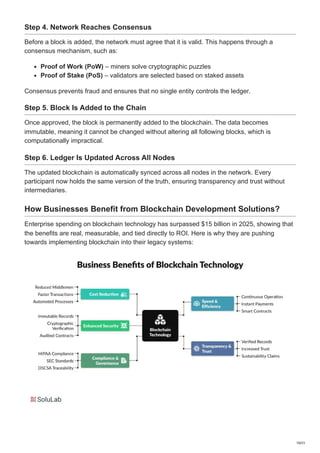
In summary, blockchain is changing business by shifting trust from institutions to mathematics. It is not a silver bullet, but a strategic tool that, when applied correctly, can radically reduce friction costs, enhance data fidelity, and unlock new economic models. The companies that thrive will be those that view blockchain not as a technological novelty, but as a fundamental redesign of how value is recorded and exchanged.
Comparative Impact Table: Traditional vs. Blockchain-Based Business Processes
| Transaction Settlement | Days, with clearinghouse intermediary | Minutes to seconds, direct peer validation |
| Supply Chain Audit | Periodic, sample-based manual checks | Continuous, immutable, full-chain verification |
| Contract Management | Legal review, manual execution, dispute resolution | Self-executing smart contracts with automatic enforcement |
| Data Ownership | Centralized database controlled by one entity | Shared, permissioned access with cryptographic privacy |
| Asset Liquidity | Low for illiquid assets, minimal fractional ownership | High liquidity via tokenization, global secondary markets |
The above comparison underscores that blockchain is not merely an incremental improvement but a categorical shift. Each row represents a fundamental change in the cost structure, risk profile, and velocity of business operations. For forward-thinking executives, the path forward is clear: begin piloting small-scale, high-impact use cases, invest in internal capability building, and engage with emerging standards bodies. The question is no longer “if” blockchain will matter, but “how quickly” your organization will adapt to a trustless, transparent future.