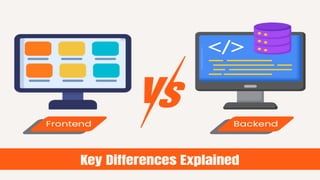
Front-End vs Back-End Development Explained
In the modern digital ecosystem, the term “web development” encompasses a complex, multi-layered discipline. For those entering the field or looking to commission a digital product, the distinction between front-end and back-end development is fundamental. While these two domains operate in tandem to deliver a seamless user experience, they address entirely different facets of engineering, logic, and architecture. This article provides a technical yet accessible breakdown of both specializations, their unique toolchains, and the critical intersection where they meet.
Defining the Front-End: The User Interface and Experience
The front-end, often referred to as the “client-side” of an application, is everything a user directly sees, touches, and interacts with within a browser or mobile application. It is the visual layer, responsible for layout, typography, color schemes, animations, and responsive behavior across devices. Front-end developers translate design mockups into live code, ensuring that the interface is not only aesthetically pleasing but also functional, accessible, and performant.
Core Technologies of the Front-End
While the ecosystem has evolved rapidly, the foundational languages remain non-negotiable. A front-end developer must possess deep proficiency in:
- HTML (HyperText Markup Language): The semantic skeleton of every page. It dictates structure, content hierarchy, and ensures that elements are properly parsed by the browser.
- CSS (Cascading Style Sheets): The presentation layer. It governs visual styling, grid systems, animations, and media queries for responsive design.
- JavaScript: The behavioral engine. It enables dynamic interactivity—from form validation to complex state management and real-time data updates without a page reload.
Modern Front-End Tooling and Frameworks
In production environments, writing vanilla JavaScript is often insufficient for large-scale applications. Consequently, developers leverage reactive frameworks that optimize component-based architecture and unidirectional data flow. Dominant tools include React, Vue.js, and Angular. Additionally, preprocessors like Sass and build tools such as Webpack or Vite are used to automate tasks, bundle assets, and enhance code maintainability.
Key Responsibilities of a Front-End Developer
Defining the Back-End: The Server, Logic, and Data
The back-end, colloquially known as the “server-side,” is the invisible infrastructure that powers the front-end. It operates on remote servers, away from the user’s device, and is responsible for processing business logic, managing database interactions, authenticating users, and enforcing security protocols. When you submit a form or search for a product, the back-end receives the request, processes it, and returns the appropriate response in JavaScript Object Notation (JSON) or XML.
Core Components of the Back-End
Back-end engineering extends far beyond simple scripting. It involves a robust understanding of server architecture, Application Programming Interfaces (APIs), and data persistence. The primary pillars include:
- Server-Side Languages: Popular choices include Python (with Django or Flask), JavaScript (Node.js/Express), Java (Spring Boot), Ruby (Rails), and Go. Each offers distinct performance and scalability characteristics.
- Databases: Managing both relational databases (PostgreSQL, MySQL) that use Structured Query Language (SQL) and non-relational / NoSQL databases (MongoDB, Redis) that store data in document or key-value formats.
- API Layer: Designing and maintaining endpoints that allow the front-end to interact with the server safely and efficiently.
Architectural Concerns in Back-End Development
Back-end developers are responsible for far more than writing functions that query a database. They must architect for concurrency, data integrity, and horizontal scaling. This involves implementing authentication protocols like OAuth and JWT, setting up serverless functions, managing containerization with Docker, and ensuring middleware handles error logging and request validation correctly.
Key Responsibilities of a Back-End Developer
The Intersection: The Full-Stack and API Contracts
Despite their distinct roles, front-end and back-end are not siloed disciplines. They communicate through a well-defined API contract, typically utilizing HTTTP methods (GET, POST, PUT, DELETE). A developer who is proficient in both areas is called a Full-Stack Developer. However, the most successful teams treat these as collaborative roles where the front-end developer understands server constraints (e.g., rate limits, payload sizes) and the back-end developer understands User Interface (UI) state management needs.
Comparative Analysis: Front-End vs Back-End
To crystallize the differences, the following table contrasts the primary dimensions of both domains.
| Primary Focus | User interface, aesthetics, and client-side interactivity | Business logic, data processing, and server security |
| Execution Environment | Runs in the user’s browser (client-side) | Runs on a remote server or cloud instance |
| Core Languages | HTML, CSS, JavaScript (with frameworks) | Python, Node.js, Java, Ruby, Go, PHP |
| Data Handling | Displays data; does not persist it permanently | Manages CRUD (Create, Read, Update, Delete) operations and data validation |
| Performance Metric | Load time, render speed, smooth animation (60 FPS) | Response latency, throughput, concurrency handling, uptime |
| Security Risk | Cross-Site Scripting (XSS), insecure UI state | SQL injection, broken authentication, data breaches |
Conclusion: Two Halves of a Cohesive Whole
Understanding the difference between front-end and back-end development is not merely an academic exercise; it is a critical prerequisite for effective project planning, hiring, and architectural decision-making. The front-end delivers the “what” and “how” of the user’s experience, while the back-end dictates the “where” and “why” of data integrity and application logic. Neither domain is inherently more valuable than the other. A successful digital product requires a symmetrical alliance between a finely tuned interface and a resilient, scalable server infrastructure. For tech leaders, the question is not which side to choose, but how to foster communication and shared context between these two vital engineering disciplines.