
Web3 and Decentralized Technology Explained: The Architecture of Digital Sovereignty
For the past three decades, the digital economy has operated on a centralized paradigm. Platforms own the data, intermediaries control the transactions, and users provide the value—often without receiving a proportionate share of the economic upside. Enter Web3: a fundamental re-architecting of the internet’s underlying infrastructure, shifting control from corporate gatekeepers to individual participants. This is not merely an incremental upgrade; it is a paradigm shift in how value, trust, and governance are coded into digital systems.
Defining the Three Eras of the Internet
To understand Web3, one must first contextualize its predecessors. Web1 (1991–2004) was the read-only web—static HTML pages, no user interaction, and no transactional layer. Web2 (2005–present) is the read-write web, defined by social media, cloud computing, and user-generated content. However, Web2’s architecture is inherently extractive: platform owners monetize user attention and data, while users bear the cost of lock-in, censorship, and privacy erosion.
Web3 introduces the read-write-own paradigm. It is a permissionless environment where users not only interact with content but also hold direct ownership over the assets, data, and protocols they use. This is achieved not through legal agreements but through cryptographic verification and economic incentives embedded in the technology itself.
The Core Pillars of Decentralized Technology
Decentralization is not a single monolithic concept. It operates across three distinct layers: architectural, political, and logical. Architectural decentralization refers to the physical distribution of nodes. Political decentralization concerns governance and control—who can alter the rules. Logical decentralization ensures that all participants share a single, consistent state, even if they don’t trust each other.
1. Blockchain: The Immutable Ledger
At the heart of Web3 lies the blockchain—a distributed, append-only ledger maintained by a network of validators. Unlike traditional databases that reside on a single server, a blockchain replicates its state across thousands of independent nodes. Each block cryptographically references the previous one, creating an immutable chain of transactions. This structure eliminates the need for a trusted central authority, as tampering with a single record would require rewriting the entire chain across a majority of the network—a computationally infeasible task.
2. Smart Contracts: Programmable Trust
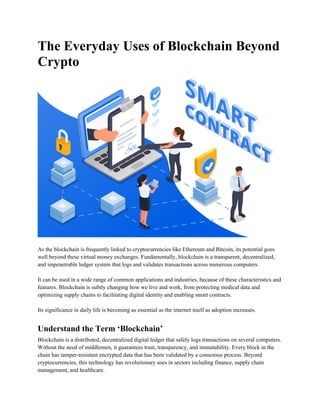
Smart contracts are self-executing agreements written in code and deployed on a blockchain. Once deployed, they operate autonomously, with execution guaranteed by the network’s consensus mechanism. This removes ambiguity and human discretion from transactions. For example, a decentralized insurance policy can automatically pay out a claim when an oracle reports a flight delay, without requiring a claims adjuster or manual approval. The code is law—transparent, auditable, and irreversible.
3. Decentralized Storage and Computation
Traditional cloud services like AWS or Google Cloud are centralized data silos. Decentralized alternatives—such as IPFS (InterPlanetary File System) and Arweave—distribute data across a peer-to-peer network, where each node stores fragments of the content. Censorship resistance is inherent: no single entity can delete or alter files. Similarly, decentralized compute networks (e.g., Akash, Golem) allow users to rent idle processing power from a global marketplace, bypassing cloud oligopolies.
Tokenomics: The Economic Engine of Web3
Web3’s architecture is incomplete without its incentive layer. Tokens are not just cryptocurrencies; they are programmable units of value that align the interests of network participants. There are two primary categories:
| Utility Tokens | Access to network services (e.g., compute, storage, governance) | Derived from network usage and demand |
| Security Tokens | Represent ownership in an underlying asset or entity | Derived from profit share or appreciation |
| Governance Tokens | Voting rights on protocol upgrade and parameters | Derived from influence and long-term protocol valuation |
This mechanism transforms users into stakeholders. Early contributors are rewarded with tokens that appreciate as the network grows, creating a virtuous cycle. However, tokenomics is a double-edged sword: poorly designed incentive structures can lead to speculation bubbles, centralization of wealth, or governance attacks. Robust protocols must carefully calibrate emission schedules, fee mechanisms, and voting thresholds.
Decentralized Autonomous Organizations (DAOs)
DAOs are the governance layer of Web3—organizations run by code, not by a board of directors. Membership is determined by token holdings, and decisions are made through on-chain voting. This enables global, borderless coordination without a legal entity. A DAO can manage a venture fund, an open-source software project, or even a physical community. Smart contracts automatically execute the agreed-upon actions, ensuring that no member can unilaterally alter the outcome.
While DAOs promise radical transparency, they face significant challenges: voter apathy, plutocratic capture (voting power concentrated among whales), and the legal ambiguity of autonomous entities. The evolution of sophisticated governance models—including quadratic voting and conviction voting—is an active area of research.
The Infrastructure Stack: From L0 to L3
Understanding Web3 requires a mental map of its layered architecture. The reference model is as follows:
This modular approach addresses the infamous blockchain trilemma: the difficulty of achieving scalability, security, and decentralization simultaneously. L2 rollups, for instance, process transactions off-chain and submit cryptographic proofs to L1, increasing throughput without sacrificing the base layer’s security.
Real-World Applications and Current Limitations
Web3 is not theoretical. Decentralized finance (DeFi) has already captured billions in total value locked, enabling permissionless lending, borrowing, and trading. Non-fungible tokens (NFTs) have redefined digital ownership for art and collectibles. Decentralized identity (DID) protocols offer a future where users control their credentials, selectively disclosing information without exposing the entire identity.
Yet, maturity comes with compromises. The user experience remains clunky—managing private keys, paying gas fees, and interacting with complex interfaces demand technical literacy. Scalability, despite L2 advances, still lags behind centralized databases. And regulatory uncertainty threatens to stifle innovation in major jurisdictions.
Conclusion: The Path Forward
Web3 is not a reaction against technology; it is a reaction against concentrated power. Decentralized technology does not merely replace servers with blockchains—it replaces hierarchical trust with cryptographic verification, closed data with open protocols, and passive users with active stakeholders. The transition will not be instantaneous, nor will it be without regulatory friction or technical setbacks. But the trajectory is clear: the future of the internet will be built on sovereignty, not surveillance; on custody, not dependency. For developers, enterprises, and policymakers, the imperative is not to ask whether to adopt Web3—but how to do so responsibly, securely, and inclusively.