
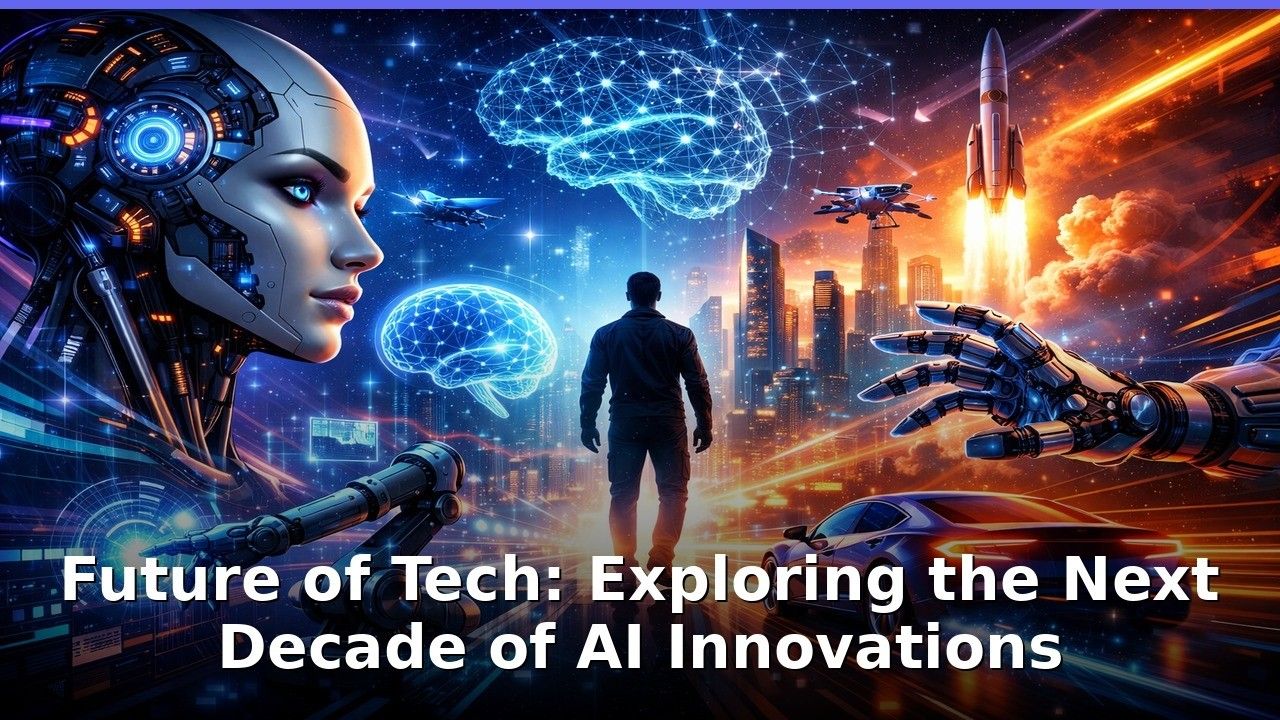
Future Innovations Changing the World: The Next Decade of Transformative Technology
The velocity of technological change is no longer linear—it is exponential. As we stand on the precipice of the 2030s, the convergence of artificial intelligence, quantum computing, biotechnology, and advanced materials is poised to redraw the boundaries of human capability. These are not incremental upgrades; they are foundational shifts that will redefine industries, economies, and the very fabric of daily existence. This article examines the most consequential innovations on the horizon, analyzing their mechanisms, their potential impact, and the strategic imperatives for leaders who must navigate this new terrain.
1. Artificial General Intelligence (AGI) and Autonomous Reasoning
While current AI systems excel at narrow tasks, the emergence of Artificial General Intelligence—machines that can reason, plan, and learn across any domain with human-level flexibility—represents the single most disruptive force in modern history. Unlike generative models that predict tokens, future AGI architectures will employ recursive self-improvement and causal inference, enabling them to solve complex scientific and logistical problems without human intervention.
The Operational Impact
In the immediate future, we will witness the transition from AI as a co-pilot to AI as an autonomous operator. Enterprises will deploy AGI-driven systems for end-to-end supply chain management, real-time market risk assessment, and even clinical trial design. The competitive advantage will no longer accrue to organizations with the largest labor pools, but to those with the most sophisticated reasoning engines.
- Self-Healing Infrastructure: Networks and data centers that detect, diagnose, and repair faults before human engineers are alerted.
- Scientific Hypothesis Generation: AGI that proposes novel chemical compounds or material structures with a 90%+ success rate in simulation.
- Strategic Simulation: Real-time war-gaming for corporate strategy, modeling competitor moves across legal, financial, and operational vectors.
However, the ethical and governance frameworks lag far behind capability. The establishment of verifiable control mechanisms—what researchers call the “alignment problem”—will be the defining technical challenge of this decade. Without robust interpretability and fail-safe protocols, AGI adoption will remain constrained to sandboxed environments, limiting its world-changing potential until trust is earned.
2. Quantum Computing: From Hype to Material Advantage
For years, quantum computing was a laboratory curiosity. That era is ending. Fault-tolerant quantum machines, leveraging topological qubits and advanced error correction, are now projected to achieve commercial relevance before 2030. The implications for cryptography, materials science, and logistics are staggering.
Breaking Cryptographic Barriers
Today’s RSA and ECC encryption standards will be rendered obsolete by Shor’s algorithm operating on a sufficiently powerful quantum processor. This is not a theoretical risk—it is a countdown. Forward-thinking organizations are already transitioning to post-quantum cryptography (PQC) to protect data with a shelf life beyond five years. The innovation here is not just computational speed; it is the creation of a new security paradigm.
| Drug Discovery | Inability to simulate molecular interactions with 100+ atoms | Exact simulation of enzymatic reactions and protein folding |
| Logistics | NP-hard problems solvable only by approximation | Optimal global routing for fleets exceeding 10,000 vehicles in real-time |
| Finance | Monte Carlo simulations with high variance | Exact pricing of complex derivatives and instant portfolio rebalancing |
The killer application, however, will be in quantum machine learning. By encoding data into high-dimensional Hilbert spaces, quantum neural networks can identify patterns invisible to classical algorithms—enabling breakthroughs in personalized medicine and climate modeling that were previously computationally intractable.
3. Biomanufacturing and Synthetic Biology
The next manufacturing revolution will not occur in factories of steel and robots; it will occur in living cells. Synthetic biology, powered by CRISPR 3.0 and AI-driven metabolic engineering, is transforming microbes into programmable micro-factories. These organisms can produce everything from jet fuel to spider silk to novel antibiotics, with zero petrochemical inputs.
Decentralized Production Networks
Traditional supply chains depend on centralized, capital-intensive plants. Biomanufacturing enables a distributed model where fermentation tanks—no larger than a shipping container—can be deployed near demand centers. This reduces transportation emissions, shortens lead times, and offers resilience against geopolitical shocks.
The critical enabler is the “design-build-test-learn” loop, now automated via robotic cloud laboratories. What previously took a team of PhDs six months can now be executed by a single operator in three days. The bottleneck is no longer scientific knowledge; it is regulatory adaptation. Agencies must evolve from reviewing individual products to certifying adaptable production platforms.
4. Energy Storage Beyond Lithium-Ion
Renewable energy’s greatest weakness has been intermittency. Solar and wind are abundant, but their output does not align with demand curves. The future of energy innovation lies in multi-day storage solutions that are safe, inexpensive, and scalable to terawatt-hour capacity.
Solid-state batteries, iron-air chemistry, and gravity-based storage systems are advancing rapidly. Yet the most promising frontier is green hydrogen produced via electrolysis powered by surplus renewable generation. Hydrogen can be stored indefinitely in salt caverns and converted back to electricity via fuel cells with efficiency rates exceeding 60%—a figure that continues to climb.
The economic inflection point will arrive when the levelized cost of stored electricity (LCOS) falls below the cost of dispatchable fossil generation. Projections indicate this crossover occurs by 2027 for iron-air systems and by 2030 for hydrogen. Once achieved, the entire concept of a “base load” power plant becomes obsolete, replaced by a resilient, distributed grid of variable renewables paired with massive storage buffers.
5. Human-Machine Interfaces and Neural Augmentation
The final frontier is the merging of silicon and biology. Brain-computer interfaces (BCIs) are evolving from invasive, experimental implants to minimally invasive, high-bandwidth cortical modems. These devices will not only restore lost motor function in paralytics but also supercharge human cognition—providing instantaneous access to vast datasets, enabling “telepathic” communication, and facilitating direct control of prosthetics and exoskeletons.
The Pragmatic Roadmap
Current BCI prototypes achieve 1,000+ electrode arrays with a signal-to-noise ratio sufficient for cursor control. The next generation, using nanoscale “neural dust” or ultrasound-based interfaces, aims for 1 million channels—enough to reconstruct the sensory and motor experience in real time.
For the knowledge economy, the more immediate innovation is the augmented workforce—wearable exosuits and AR glasses that reduce physical strain and deliver context-aware procedural guidance. A warehouse worker or surgeon equipped with such tools achieves performance levels 30-40% higher than their unassisted peers. This does not represent job displacement but rather a redefinition of the skillset required for peak performance.
Conclusion: The Strategic Imperative
These innovations are not isolated trajectories; they intersect and amplify one another. Quantum computers will design the catalysts for synthetic biology. AGI will optimize the logistics of green hydrogen. Neural interfaces will allow humans to supervise fleets of autonomous bioreactors. The organizations that succeed will be those that adopt a portfolio-based innovation strategy, investing in fundamental R&D across multiple horizons while maintaining the organizational agility to pivot rapidly.
The window for early advantage is closing. The infrastructure, talent, and governance required to harness these forces cannot be built overnight. The world is not changing—it has already changed. The only question is whether you are writing the new rules or simply reading about them in the aftermath.