
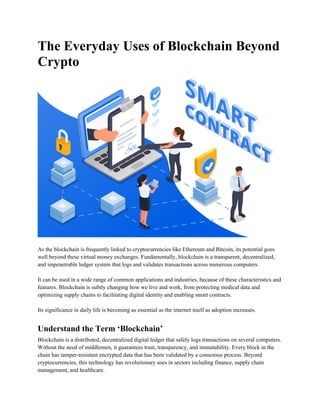
Blockchain Applications Beyond Crypto: The Distributed Ledger Revolution
For the past decade, the term “blockchain” has been almost synonymous with cryptocurrencies like Bitcoin and Ethereum. However, the underlying technology—a decentralized, immutable, and transparent ledger—has evolved far beyond the realm of digital assets. Enterprises, governments, and research institutions are now deploying blockchain to solve complex problems related to trust, provenance, and data integrity. This article explores the most impactful non-crypto applications of blockchain technology, moving from theoretical potential to operational reality.
Supply Chain Provenance and Traceability
Global supply chains are notoriously opaque. A consumer purchasing a diamond, a pharmaceutical product, or a coffee bag often has no verifiable way to trace its journey from origin to shelf. Traditional databases are centralized, making them susceptible to manipulation and single points of failure. Blockchain addresses this by providing a shared, tamper-evident record of every transaction or event.
In practice, companies like IBM and Maersk have developed platforms such as TradeLens to digitize shipping documents. Each container movement, customs clearance, and bill of lading is recorded as a block. This reduces paperwork errors by up to 40% and cuts transit times by eliminating redundant verification. More importantly, for industries like food safety, blockchain enables instant tracing of contamination sources. If a batch of lettuce is infected, the system can identify the exact farm and distribution path in minutes, not weeks, thereby minimizing health risks and financial losses.
Key Benefits for Supply Chain
- Immutable audit trails: Every handoff is recorded cryptographically.
- Reduced counterfeiting: Luxury goods and electronics can be authenticated via unique digital certificates.
- Real-time visibility: All stakeholders—suppliers, regulators, and customers—see the same data.
Digital Identity and Self-Sovereign Data
Identity management is broken in the digital age. Users rely on centralized entities (banks, governments, social media platforms) to verify who they are, creating honeypots of personal data vulnerable to breaches. Blockchain introduces the concept of self-sovereign identity (SSI), where individuals control their own credentials without a central authority.
In this model, a user holds a digital wallet containing verifiable credentials—such as a driver’s license or a university degree—issued by trusted authorities. When interacting with a service provider, the user presents a cryptographic proof without revealing unnecessary details. For instance, you can prove you are over 18 without disclosing your exact birth date. This has profound implications for KYC (Know Your Customer) compliance, online voting, and refugee services where individuals lack traditional documentation.
Estonia’s e-Residency program is a pioneering example. It offers a blockchain-based digital identity to non-residents, allowing them to sign documents, register companies, and access banking services remotely. This eliminates identity theft and reduces the administrative burden on both citizens and the state.
Healthcare Data Interoperability and Security
Healthcare suffers from fragmented data silos. Patient records are scattered across hospitals, clinics, and insurers, often incompatible with each other. Blockchain cannot store large medical images or genomic sequences efficiently, but it excels at managing access rights and audit logs. By creating a decentralized index of patient records, blockchain allows authorized providers to locate and request data instantly, while the patient maintains a complete log of who accessed their information and why.
Smart contracts can automate consent management. A patient can pre-authorize a specialist to view their records for a specific treatment window. Once the window expires, access is automatically revoked. This reduces administrative costs and, more critically, prevents unauthorized data leaks. Pilot projects at institutions like Massachusetts General Hospital have demonstrated that blockchain-based consent management reduces data reconciliation time by 60% while ensuring compliance with regulations like HIPAA and GDPR.
Intellectual Property and Royalty Distribution
For creators—musicians, writers, software developers, and photographers—proving ownership and collecting royalties is often opaque. Blockchain provides an unalterable timestamp for each creation, serving as definitive proof of originality. This is particularly valuable in patent disputes without the cost of expensive legal registration.
Beyond registration, smart contracts can automate royalty payments. For example, a music streaming platform can deploy a blockchain contract that splits revenue instantly between the artist, songwriter, and label each time a track is played. This removes the historical lag of months and the opaque accounting of central intermediaries. Non-fungible tokens (NFTs) have already demonstrated this capability for digital art, but the underlying mechanism applies to any licensable content. This model ensures transparent, frictionless micro-payments for intellectual property usage.
Smart Contracts in Legal and Real Estate
The legal industry relies on manual verification, escrow agents, and title searches. Real estate transactions, in particular, are slow and expensive due to the need for title insurance and notarization. Blockchain-based smart contracts can automate the entire escrow process. A contract can hold the digital deed and the payment in a cryptographic vault. When the buyer’s funds are confirmed, the contract automatically transfers the deed to the buyer and releases the funds to the seller. No intermediary is needed.
It is critical to distinguish between automation and legal judgment. Smart contracts are not intelligent; they execute deterministic logic. However, for conditional agreements—such as “pay the contractor when the milestone is verified”—they eliminate disputes. Governments in regions like Dubai and Zug, Switzerland, have begun recognizing blockchain-based titles as legally valid, reducing property transfer times from weeks to hours.
Government Voting and Public Records
Elections are the cornerstone of democracy, yet voter turnout is often low, and public trust in electoral integrity is eroding. Blockchain-based voting systems can offer a secure, auditable, and anonymous mechanism. Each citizen receives a unique, encrypted token that represents their vote. The vote is recorded on a distributed ledger, making it nearly impossible to alter or delete.
The security architecture is distinct from crypto transactions: votes must be anonymized to prevent coercion. Solutions use zero-knowledge proofs, which verify that a vote was counted without revealing the voter’s choice. While full-scale national elections are still experimental, many organizations (e.g., the state of West Virginia for overseas military voters) have piloted such systems with success. Auditors can mathematically verify the final tally against the ledger’s hash without compromising individual privacy.
Insurance and Claims Automation
Insurance claims are mired in paperwork, fraud, and lengthy investigations. Parameter-based insurance policies (e.g., flight delay or crop failure) are ideal for blockchain automation. A smart contract can listen to verified external data feeds (oracles) for a specific trigger. If a flight is delayed by three hours, the contract automatically pays the insured party’s account. There is no claim submission or manual review process.
For more complex claims, blockchain facilitates a “single source of truth” among multiple insurers and re-insurers. In the case of a natural disaster, each policy and claim document is hashed and stored on-chain. Loss adjusters can access the immutable history, reducing disputes about policy versions or coverage limits. This cuts claim processing costs by up to 30% and dramatically improves customer satisfaction.
Cross-Industry Comparison of Blockchain Use Cases
| Supply Chain | Counterfeit goods | Immutable provenance tracking | High (Enterprise) |
| Identity | Centralized data breaches | Self-sovereign credentials | Medium (Pilots) |
| Healthcare | Fragmented records | Consent management & audit logs | Medium (Research) |
| Intellectual Property | Royalty delays | Smart contract payments | Medium (NFTs/Streaming) |
| Real Estate | Title dispute | Automated escrow & title ledger | Low (Jurisdiction-specific) |
| Government | Voter fraud | Anonymous ledger voting | Low (Pilots) |
| Insurance | Slow claims | Parametric smart contracts | Medium (Commercial) |
Challenges and the Path Forward
Despite these promising applications, blockchain is not a silver bullet. The technology faces significant hurdles: scalability (throughput is lower than traditional databases), regulatory uncertainty, and the oracle problem (the need for trusted off-chain data to trigger contracts). Moreover, the environmental cost of energy-intensive consensus mechanisms (proof-of-work) is a legitimate concern, leading to the rise of more efficient models like proof-of-stake.
Nevertheless, the core value proposition remains intact: blockchain replaces institutional trust with cryptographic verification. As enterprises move from pilot projects to production systems, the most successful implementations will focus on collaborative networks where multiple parties share a common, immutable ledger—not on replacing robust internal databases. The future of blockchain is not about disrupting money; it is about re-architecting how organizations exchange value, verify claims, and maintain records in an increasingly digital world.