
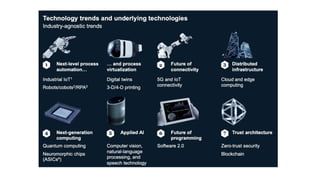
Emerging Technologies That Will Shape the Future
The pace of technological innovation is no longer linear; it is exponential. For enterprises, investors, and policymakers, understanding the trajectory of emerging technologies is not a matter of intellectual curiosity—it is a strategic imperative. The next decade will witness the convergence of several independent fields, creating a synergy that will redefine productivity, human capability, and economic structures. This article dissects the most consequential technologies, their current maturity, and their projected impact on the global stage.
1. Artificial Intelligence and Autonomous Agents
Artificial intelligence has moved beyond predictive analytics and natural language processing into the realm of autonomous agency. The future of AI is not a chatbot that responds to prompts, but a system that initiates tasks, manages workflows, and negotiates with other systems. This shift from generative AI to agentic AI will transform enterprise software from a passive tool into an active participant in business operations.
The Rise of Multi-Modal Reasoning
Future AI models will not be confined to text or images. They will process video, audio, sensor data, and code simultaneously, enabling real-time decision-making in complex environments such as automated logistics, precision agriculture, and autonomous robotics. The key metric will shift from model size to contextual reliability—the ability to maintain accuracy over long, unstructured sequences of actions.
- Impact on Workforce: Augmentation of knowledge workers, not replacement. AI will handle routine analysis, freeing humans for strategic judgment.
- Risk Factor: Model governance and explainability will become critical bottlenecks for adoption in regulated industries.
2. Spatial Computing and the Metaverse Infrastructure
While the metaverse hype of 2021 has faded, the underlying technology—spatial computing—has matured significantly. This is not about virtual reality headsets for gaming; it is about the precise overlay of digital data onto physical space. Advanced LiDAR, simultaneous localization and mapping (SLAM), and high-bandwidth 5G/6G connectivity will make spatial interfaces the standard for industrial training, remote surgery, and collaborative design.
The future lies in digital twins—dynamic, real-time virtual replicas of physical assets. These twins will simulate entire supply chains, urban infrastructure, and even human physiology for drug testing. The ability to run “what-if” scenarios on a digital twin before implementing changes in the physical world will reduce costs and risk by orders of magnitude.
3. Quantum Computing as a Service
Quantum computing remains the most disruptive yet least understood frontier. The transition from noisy intermediate-scale quantum (NISQ) devices to fault-tolerant quantum computers is projected to occur within the next decade. However, the strategic advantage will not come from owning quantum hardware, but from leveraging quantum cloud services.
Practical Use Cases Beyond Cryptography
While much attention is paid to breaking RSA encryption, the commercial value lies in optimization and simulation. Financial institutions will use quantum annealing for portfolio optimization, logistics companies for route planning in real-time, and pharmaceutical firms for molecular simulation that classical computers cannot solve. The future will see hybrid classical-quantum algorithms, where classical systems handle data preprocessing and quantum systems solve the core combinatorial problem.
| AI Agents | Early commercial adoption | 2026-2028 |
| Spatial Computing | Enterprise pilot programs | 2027-2029 |
| Quantum Computing | Research & limited cloud access | 2030-2035 |
| Neuromorphic Hardware | Prototype stage | 2029-2032 |
4. Neuromorphic and Energy-Efficient Hardware
The exponential growth of AI is hitting a wall: energy consumption. Current GPU-centric data centers are unsustainable. The response is neuromorphic computing—chips that mimic the neural structure of the brain, using spiking neural networks (SNNs) that process data in event-driven pulses rather than continuous calculations. This architecture offers a 1000x improvement in energy efficiency per operation compared to von Neumann systems.
Furthermore, photonic computing, which uses light instead of electricity for data transmission, will eliminate latency bottlenecks in hyperscale data centers. The combination of these hardware innovations will enable edge AI—intelligent devices that operate without constant cloud connectivity, a prerequisite for true autonomous vehicles and remote industrial IoT.
5. Biotechnology and Bio-Convergence
The future of technology is inseparable from biology. The convergence of AI, automation, and bioinformatics is accelerating the design of synthetic organisms for manufacturing, carbon capture, and targeted drug delivery. This is not just healthcare; it is biofabrication.
CRISPR gene editing is evolving from a research tool into a therapeutic platform. Coupled with AI-driven protein structure prediction (such as AlphaFold successors), researchers will design custom enzymes that degrade plastic waste, produce rare chemicals in fermentation tanks, or perform targeted immune responses. The integration of biological components with silicon chips—bio-hybrid systems—will create sensors with unprecedented specificity.
6. Advanced Energy Storage and Grid-Edge Intelligence
Every technology discussed above depends on a reliable, abundant energy source. The future will see a shift from single-purpose batteries to solid-state batteries with higher energy density and lithium-sulfur alternatives that remove reliance on rare earth metals. More importantly, the energy grid will become an active, distributed intelligence network.
Edge computing will enable microgrids to autonomously balance supply and demand between solar panels, wind turbines, and electric vehicle batteries. Transactive energy markets will allow households to sell stored energy back to the grid in real-time, driven by AI algorithms that predict price volatility and weather patterns. This decentralized model is the backbone for sustainable urbanization.
Strategic Implementation Roadmap
Conclusion: The Convergence Imperative
The greatest risk is not the failure of any single technology, but the inability to integrate them. A quantum computer is useless without an AI-driven interface; a digital twin is meaningless without IoT sensors; a synthetic organism is inefficient without automated bioprocessing. The winning organizations of 2035 will not be those who adopt the flashiest tool, but those who architect a coherent ecosystem where data flows seamlessly from the physical world to the digital layer and back. The future is not a linear progression—it is a mosaic where each tile reinforces the others. Leaders must invest not only in technology, but in the organizational redesign required to harness this convergence. The era of isolated innovation is over; the era of systemic transformation has begun.